
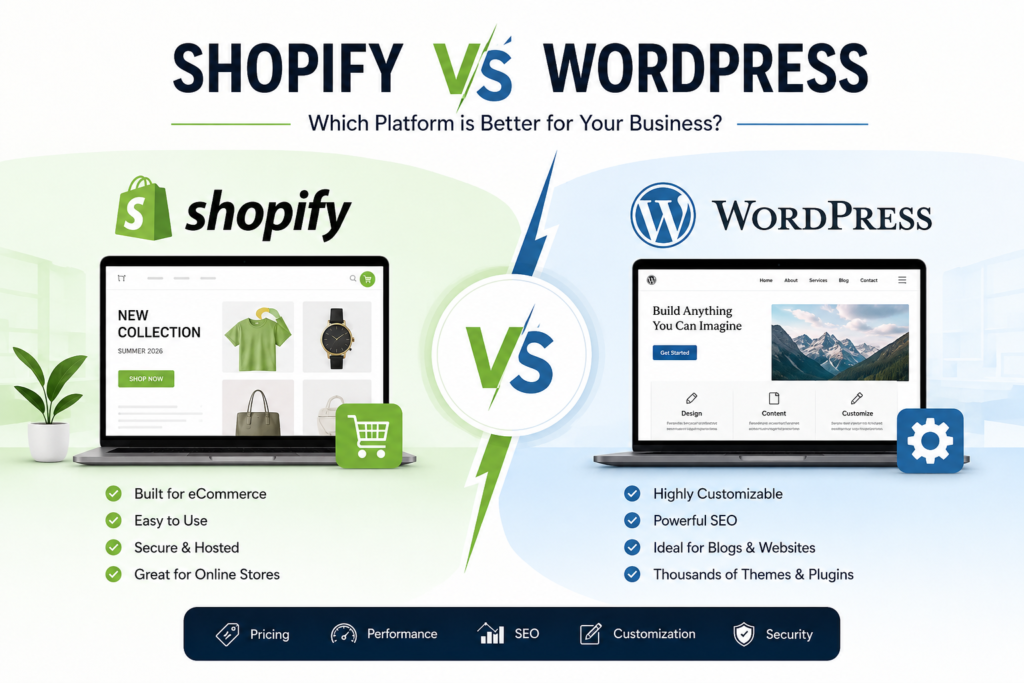
One of the most important decisions you’ll make for your business is the website platform you choose. If you’re opening an online store, creating a business website, or building a personal brand, Shopify and WordPress are two of the most popular options.
Both have powerful features but they are for different purposes. In this guide, we’ll be comparing Shopify vs WordPress in detail to help you decide which platform is better suited for your business needs.
What is Shopify?
Shopify is an eCommerce platform built specifically for selling products online. It has everything you need to build, run and grow an online store, without needing to be a tech expert.
Major Features
User-friendly interface
Hosting included (secure)
Mobile responsive themes
Pre-installed payment gateways
Inventory control
Marketing tools.
App Store with thousands of integrations 4.
What is WordPress?
WordPress is the world’s most popular content management system (CMS). It allows you to create blogs, business sites, portfolios and online shops with plugins like WooCommerce.
Unlike Shopify, WordPress gives the user full control of their website.
Main Features
Highly adaptable
Thousands of themes
More than 60,000 plugins
Excellent blogging features
Total SEO control
Great for all sorts of websites
Shopify versus WordPress: A Feature Comparison
- Easy to use Shopify
Shopify is very beginner friendly. Build a store in a few hours without coding
Best For:
Novice’s
Small business
Online Shopping
WordPress More
There is a learning curve to WordPress. You need hosting, themes, plugins and occasional maintenance.
Best For:
Developers Agencies
Businesses requiring flexibility
Winner: Shopify)
Design & Customisation Shopify
Themes in the profession
Simple customisation
Limited versus WordPress WordPress
Fully customisable
A thousand subjects
Total control over design
Winner : WordPress
SEO
SEO is kinda essential, if you want your site to show up higher on Google, and be noticed more often
Shopify SEO
Fast loading, SSL included
SEO-friendly URLs
Built-in sitemap
WordPress SEO
And yeah , with plugins like Yoast SEO or Rank Math , WordPress gives you more advanced optimization stuff including
Meta titles
Meta descriptions
Schema markup
Redirect management
Internal linking
So , i guess the winner here is WordPress.
eCommerce Features
Shopify was built mainly for online stores, basically that’s the whole idea
Features include:
Product management
Inventory tracking
Order management
Shipping integrations
Payment gateways
Discount codes
WordPress, on the other hand , needs WooCommerce to get the same kind of functionality
Winner: Shopify
Pricing
Shopify
You pay for monthly subscription plans, and they already include hosting and security
Still, there can be extra costs, like
Premium themes
Paid apps
Transaction fees
WordPress
The costs depend on a few things, like
Hosting
Domain
Premium themes
Plugins
Maintenance
Winner: Depends on your budget
Security
Shopify
Security is basically fully handled for you
Includes
SSL certificate
PCI compliance
Automatic updates
Secure hosting
WordPress
Security depends on your hosting provider, and also on the plugins you install. Regular updates , and backups are kind of on you though , yep
Winner: Shopify
Performance
Shopify gives you optimized hosting, and the website speed is usually excellent
WordPress performance depends on
Hosting quality
Theme
Plugins
Image optimization
Winner: Shopify
Conclusion
The conclusion is that the choice between Shopify and WordPress depends on the individual needs of a business, its capabilities, and its budget. So, if someone is looking for an easier way to set up an online shop, and prefers a self-managed platform, then Shopify is the perfect option for them due to a number of remarkable features that the platform provides, including an outstanding eCommerce functionality, high security, and its simplicity.
On the other hand, WordPress can be an amazing option for people who want to have as much control as possible over their websites and are willing to use the best SEO features and customize their website to fit their business needs.